Blog

Showing posts with label Practical. Show all posts

Sunday, 1 January 2017

Our Set:

Our set consists of four, two tiered rostrum, with the wooden tops on both layers. We made this decision as, whilst it is typical of total theatre to have minimal props, there are certain props we found necessary to change costume (see below). Also in relation to costume, we have a white sheet over the rostrum. This is also used to make the table look like a surgery table which plays into the storyline and the original use of the table. We decided on the table itself after we were first introduced to the script with the surgery table preparation scene (see scene five, picture one). We decided that in order to obtain the robotic interpretation of the ambassadors we wanted we needed a uniform set, so a rostrum to a person seemed most appropriate, and this only furthered the more we developed our ambassador scenes and experimented with synchronised, repetitive and exaggerated movements.

Scene One:


This scene we wanted to be create an impact on the audience, it being our first scene, so we decided to make it one of our most dynamic scenes and direct the majority of the lines at the audience (or at least say the lines out to the audience. We extended the first line in order to achieve this, as it meant that we could introduce the clear hierarchy between the ambassadors by having Jasmine give orders to the others; who reply with sharp, quick movements, with Chloe's nervous disposition around Jasmine showing. We ensured there was a movement per line and complemented this energetic start with certain lines, that particularly convey collective beliefs/ attitudes, said in unison. This is representative of the group mentality we thought was so prominent in the ambassadors (with the exceptions of Hannah and Chloe).

Scene Two:


We originally struggled with this scene as, having begun with the scenes with the ambassadors, we found transitioning between them, and their lines which are so very enabling of the total theatre style; and the birthday people, who we interpreted to be much more natural and disjointed, quite difficult. We wanted to find a way to convey this opinion of the characteristics of the birthday people whilst upholding our elected style. In order to progress we decided to look at more practical approach, by deciding on lighting. As we decided on our set based on the ambassadors, we wanted the lighting to be set for the birthday people in its own right. We decided to use the lights to demonstrate the changing relationships and opinions of the birthday people and to convey the fact they are all locked in. We intend to have a spotlight each, from which we can't move out of, and these spotlights will decrease per scene change forcing us to group with others based on whether they sided with Alexis or Silas or were still undecided. This made choreographing movement much easier as we had limited our movement and given ourselves boundaries. Also, as the lights were communicative on the main themes of the scenes with the birthday people in general, we were able to focus on introducing the characters and find ways to initiate the relationships between the characters. This consisted of more or less direct communication with others (as opposed to speaking out to the audience despite being in conversation with someone) and whether or not our characters participated in the synchronised movements. We decided to begin with simply turning our heads and saying certain (more panicked) lines in unison, excluding Silas as they are the only one of the birthday people to be outspokenly against the situation from the very beginning. We have yet to devise around the middle section (pictures 3-5 and half of 6). By the end we decided to make the movements and vocals more exaggerated implying the group have been effected in some way (either in excitement or nervousness) by Jasmine's visit. In particular when Silas says 'What will they do? Stitch my mouth closed?', we do violent actions and follow the line with Alexis saying 'Yeah stop. Don't ruin the operation.' and all of us finishing her line but saying the sentences in a different order in order to make what we viewed as a "mantra" of sorts more frantic and encourage a discomfort in the audience at the apparent "brainwashing" to comply with these enforced societal values and conventions.


Scene Three:


This scene was the only development we had in Hannah's story, however we wanted the audience to become quite invested in her character to make her ambiguous ending more frustrating, as we felt this was an important part of the play's intentions. We believed it left the play open to discussion as whilst the events surrounding the birthday people were complete and Jasmine's mentality made no room for compromise, Hannah's character is a loose end and therefore allows the audience to discuss what should have happened to her, and what they think would have happened. In order for this to take most effect we ensured that, whilst Hannah was sat at the front speaking out to the audience in a natural manner, the others are very exaggerated and surreal.


Scene Five:


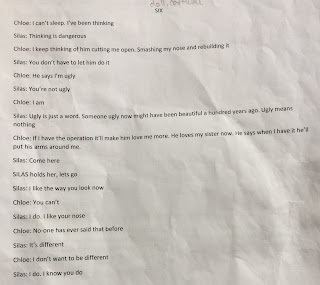
This scene (the first picture) was the first scene we saw of the play and the first time any of us had experimented with total theatre techniques. We took inspiration from Panic! at the Disco's 'This is Gospel' music video, in that we wanted swift hand gestures and a well co-ordinated looking effect.


We then had to transition into a small duologue between Jasmine and Paloma. We decided to have the conversation's key moments marked by Hannah and Chloe's pauses in their repetitive movements. The last line is said by everyone in order to emphasize just how important looking perfect is to these involved.


Transitions:


Our transitions were inspired by the 'Doll on a Music Box' scene from Chitty Chitty Bang Bang. We wanted to use the mechanical movements total theatre uses in a more literal manner, and after discussing how we felt the ambassadors to be encouraging an emotionless, "porcelain doll"-type effect on others, we decided to replicate the staccato movements with the questions seen above directed at the audience in a more sinister illustration on the impact the Beauty Manifesto has on their society.


Costume Changes:


In a play I saw rather recently: Richard the Third, adapted by Crude Apache, the use of torches prompted discussion in our devised lesson. However, whilst we found no use for them in relation to our devised, we became enthused by the idea of using a torch to create shadows in our scripted piece.


We intent to use the sheet on the table, and pick it up and hold it at the front of the stage. The torch will then be switched on and costume will be changed in a stylised manner, with those changing swapping position with those holding the sheet once finished. This should create a version of the above effect.


Costume Choice:

Our costume consists of all four of us (regardless of gender) wearing a skirt and blouse, and then changing into heels and lab coats when we become ambassadors. We decided on this as we wanted something highly feminine and reasonably mobile that was still up for alteration depending on character, but that was also somewhat uniform. We use lab coats and occasionally gloves to maintain the professionalism and authority of the ambassadors, and the high heels to convey the extra step further they go than the birthday people in their strive for perfection.


What We Have Left:

Scene Four-


Scene Six-


Scene Seven-


Tuesday, 15 November 2016

So far we have progressed through 2 full units of Beauty Manifesto and part way through another (the 2 completed of which as seen in the images bellow). The third we decided to draw upon the work we did in our Paper Birds workshop, by utilising the section of physical theatre involving putting pressure on your partner in a movement sequence. This is combined with repetitive speech and follows a segment said in unison. This movement sequence by Zoë and Abi allows time for me to transition between my character as one of the Birthday People, to Jasmine the Ambassador.


In addition we have decided upon a few elements we want to include throughout the performance. 


First we considered lighting and proxemics, deciding that in order to convey the restriction the room placed on the Birthday People, they would remain within spotlights, their movements therefore having constraints. This would also allow us to demonstrate the ever-changing relationships between the characters. Each time we revisit the storyline of the Birthday people the number of spotlights will reduce as groups form and mindsets are changed- the spotlights will reduce and characters will change groups until Alexis is in her own spotlight and all that their characters are in another.


Second we considered character changes and consequent costume changes. We decided that we would use a clothes railing with strips of stretchy, white fabric covering it; this means we can change behind it and step through it as a new character.


Saturday, 29 October 2016


The Paper Birds workshop consisted of us creating short, movement based scenes constructed off our stimulus.

Our warm up was comprised of a series of activities that revolved around synchronised movement. We did a mirroring exercise whereby we started in pairs doing small movements, and progressed into moving around the room where we then grouped with other pairs until the whole room was working like an ensemble.  

Our first task was to create a sequence of movements based on themes we took from our stimulus and what we thought was happening in the photo (what they are doing in the sea, what they are thinking/ feeling).

Next we created caricatures of old people, finding stereotypical phrases we thought would be associated with the elderly and put movement to them. We developed this by doing the movements themselves but removed of any character whilst reading facts about loneliness, and then repeating with our over exaggerated characters.

Then we composed a version of a chair duet (for want of a better term), whereby one of us were in the chair (in a group of three) and the other two had to try and get them out of it; however, whilst there was no resistance, the person in the chair would return instantly. We tried this at different speeds.

Finally we watched a direct address devising technique in process. A group began at the back of the room and would say lines from various different texts they were given, interrupting each other and pushing in front of one another. Should we decide upon epic theatre for our devised piece, I feel this would be a good technique to experiment with to make direct address and educating the audience more dynamic.

Tuesday, 4 October 2016

Here are the roles we have decided on:

Myself- Jasmine, Sam

Charlie- Chloe, Alexis

Zoë- Silas, Hannah

Abi- Ella, Paloma and Rachel (we have combined their lines under the name Paloma)

We have cut the character David.
We have composed a chair duet to the song 'Mr Sandman', as inspired by an image from a DV8 performance.

We began this process by splitting in half and devising a chair duet each that only required the movement of our arms. This meant that when we came together we could act as if we were casually watching TV ad were in a normal scenario, whilst our arms moved robotically. We particularly liked the juxtaposition of the movements and our postures.

We laid out our chair duet whereby Zoë and myself did our chair duet, we all did a series of repetitive movements in unison, and we finished with Charlie and Abi' chair duet.

Wednesday, 21 September 2016

We have decided on the play Beauty Manifesto, by Neil Leyshon. This takes place in a world where you are expected to have plastic surgery in order to be the most beautiful version of yourself you can be. The Beauty Manifesto, that specifies why such a system would be in place, is 'applied to all', 'there are no exceptions'.

In this lesson we began to decide our staging, which is four tall rostrum pushed together in order to create the surgical table. We decided we wanted the immanency of the surgery to be apparent throughout, as well as implying the omnipresence of the Beauty Manifesto.

Sunday, 18 September 2016


We began the lesson with a warm up that centred round the importance of exaggeration in Berkoff styled theatre, taking everyday activities such as getting up in the morning and making them more dramatic. We also looked at a section of a Berkoff performance (see Zoë’s blog) and recognised the robotic nature of Berkoff that we felt really complemented the section of Beauty Manifesto we were then given. We then devised around the section of script:


Friday, 9 September 2016


Berkoff is a British practitioner whose career has spanned from 1965 to today.


His physical, exaggerated style of theatre is both popular and controversial, defying the norms of naturalistic theatre.


Background History:

Steven Berkoff was born in Stepney, London in 1937, and is still an energised actor, playwright and director. His grandparents left Russia for England in the 1890s. Diary of a Juvenile Delinquent, written by Berkoff, is an informative insight into the Jewish young man, growing up in the east end of London.

Berkoff trained as an actor at the Webber Douglas Academy in London and studied movement at the Ecole Internationale de Theatre de Jaques Lecoq in Paris. These two disciplines are key to his creative work. He worked as a mime and physical theatre practitioner at Webber Douglas and first experimented with The Trial using an ensemble of students. In 1968, Berkoff formed the London Theatre Group and like another influential actor/director, Laurence Olivier, proceeded to write, direct and perform with his own company.

The 1970s were a time of rapid change. With the end of censorship, a new writing culture permeated British theatre. Berkoff featured in his own experimental adaptations of Kafka’s The Trial and Metamorphosis, Poe’s The Fall of the House of Usher, as well as appearing in iconic films of the period.


Features of Berkovian Theatre:

What sets Berkoff apart from theatre is his focus on non-naturalism, his attention on movement rather than voice.  As an actor, director and playwright and general non-conformist, Berkoff wanted to shake naturalistic theatre and encourage experiment using the idea of Total Theatre. He believed that the only purpose of a script is to help minimalize and physicalize the story; stripping it down to the bare components.

Total Theatre maintains that every aspect of theatre must have purpose: every movement, that is choreographed; to each line, that is learned perfectly; to each lighting effect, that is used to convey a mood or message; to each sound effect, that enhances the audience’s experience; to each prop that has a use. 


The aim of Total Theatre is to create extreme moods to give the audience an overwhelming experience and to shock, amuse, scare, or amaze them. Berkoff particularly embraced this in his Kafka adaptations such as Metamorphosis, The Trial and In the Penal Colony. As a result of Total Theatre, performances are often minimalist, with bare stages and little language so that the focus remains on the physical movement and not on all the effects or the creation of a scene. This serves to detach the audience from the play and make them think about what was being said (much like Brecht, who greatly influenced Berkoff as a practitioner).


"Total theatre is a use of the imagination. Actors express the genius of the body. Express the story without a set".

Steven Berkoff said that his career owes much to his training as a physical theatre practitioner, but perhaps equally, to his working class origins, which, he maintains, give him a different perspective to those around him in a predominantly middle class profession.

Berkoff’s work is influenced by Greek theatre, Japanese Noh and Kabuki, Shakespeare, East End music hall and his Jewish heritage, as well as using the techniques of practitioners like Artaud and Brecht. His own actor training would have included Stanislavski and the techniques used by Lecoq. The use of mime, stylized movement, exaggerated vocal work, direct asides and improvisations within an ensemble environment are all key features.


Characterisation:
Berkoff was a Marxist and so often his politics would be mirrored in his productions. All parts of a play were created like a ballet, a Greek chorus as the actors became the style of the play. 

He tends to use actors as "malleable shapes and forms." 


'Decadence
' is a satire - ungovernable prejudices performed by very upper class people. Berkoff used techniques in decadence such as: miming smoking and pouring champagne and making his own sound effects. He said that "like smoking, naturalism can damage your health." 

In Metamorphosis he used ritualistic miming in the scene with the eating family, which was mirrored in the ritualistic beetle/boy character. As an insect, he moved with sharp motions, staying completely still save for the short and snappy movements. 


Berkovian actors use techniques such as background movement, repetitive actions, and mime to explore further the ways in which Berkoff approaches exchanges between two characters. Berkoff said that it was important to see how he could bring mime together with the spoken word as its opposite partner, creating the form and structure of the piece.

Examples:

Wednesday, 7 September 2016

We found our four themes could be separated into groups:

-          Lack of diversity and absence of personality, and


-          Liminal and Sonder


Lack of diversity and absence of personality:


Berkoff’s style was heavily influenced by Kabuki theatre. This implies he focuses mainly on physicality as opposed to voice, due to the fact that Kabuki actors would assume monotonous tones of voice, and convey emotion with body language. This has inspired the idea of using masks. We are considering the use of masks during transitions as, whilst there may be no speech, we will still be able to evoke a strong reaction in the audience.

Also with Kabuki theatre, the topics ae usually centred about a deep moral conflict. This combined with Berkoff’s Marxist influences has encouraged our ideas surrounding societal expectations and the discriminatory behaviour that can sometimes result from this. Berkoff’s theatre often has misogynistic elements because, as Berkoff says, “there are a lot of sexist people”.

Berkoff often uses ritualistic, exaggerated, repetitive movements; which would fit well with our idea of physicalizing compliancy.

Liminal and Sonder:

We felt like a liminal setting would support Berkoff’s style due to the shock he aimed for the audience to experience. Being in an in-between setting implies a generalisability to the performance. We were considering a sea/ river or crossroads setting.

In regards to Sonder, we have interpreted it as an extreme empathy, which we may pursue within our performance or as what we want from the audience.


Tuesday, 6 September 2016


Having chosen the image 'Another Place', we refined our ideas to the following key points-

- Lack of diversity 

- Sonder (the feeling of acknowledging that strangers/ other people's lives are just as vivid and intense as your own)

- Eliminal 

- Absence of personality

We found that the themes could consistently be applied to society and societal pressures. Of which, we discussed-

- Education (ref. 'Another Brick in the Wall Part 2, Pink Floyd music video)

- Laws and Rules

- Your conscience and the difference between what you say and what you think

- How people look and present themselves

- Religion

- Sexuality and gender (in particular we discussed the change in acceptance from generation to generation; and how "casual"-isms still seem to be prevalent, as demonstrated by toilet signs which not only encourage gender expression conformity, but also discriminate against those of a non-binary gender)